
A new poll finds that the majority of Americans would consider going without health insurance if their premiums were to double. As Congress continues to grapple with possible legislation to extend Affordable Care Act (ACA) subsidies, many Americans are already seeing considerable price hikes for their healthcare premiums for 2026. These tax credits have provided financial assistance for enrollees to afford a healthcare plan in the ACA Marketplace, but they are set to expire at the end of 2025 if they are not extended. If this were to happen, the non-profit organization KFF finds that this would more than double premiums on average, which would lead to many of the 22 million people who currently receive this tax credit to consider going without a healthcare plan next year.
Most Marketplace enrollees already find it “difficult” to afford healthcare costs
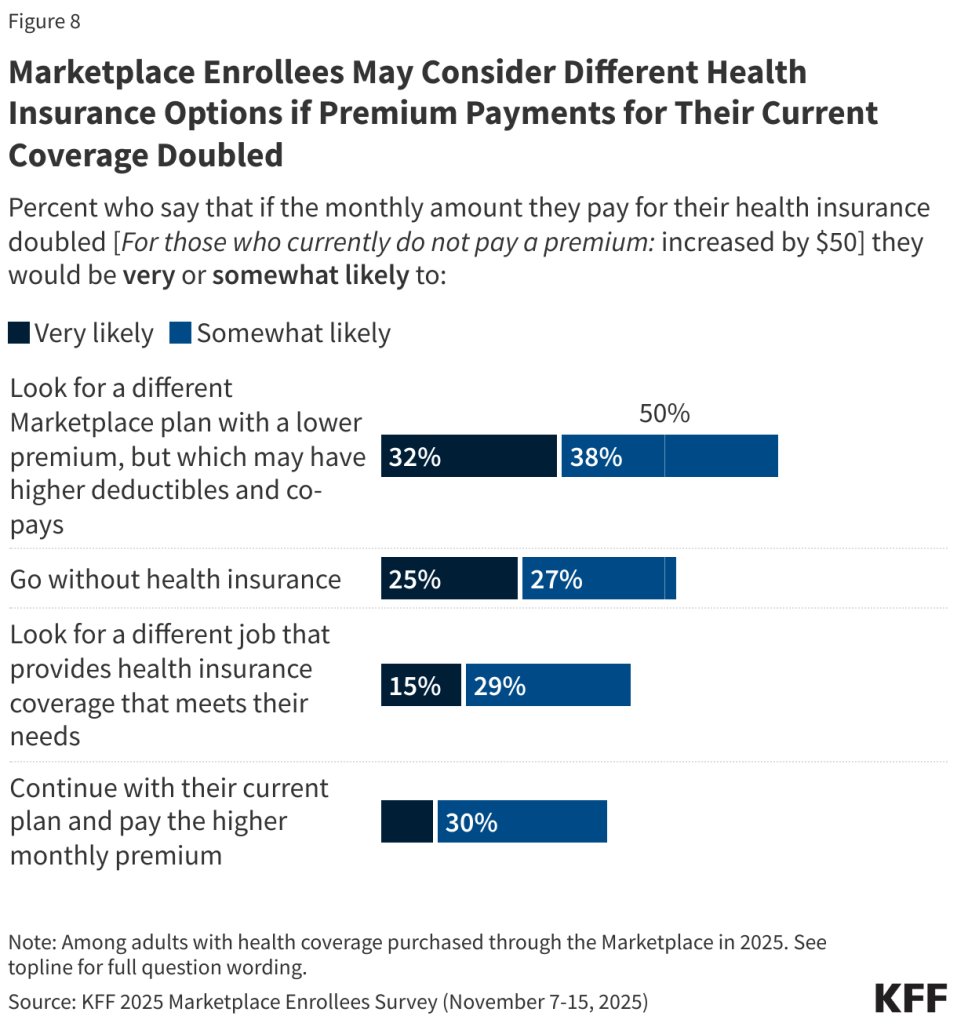
According to a survey released by the KFF on December 4 that polled 1,350 US adults, over 50% of respondents said they would would be “very likely” (25%) or “somewhat likely” (27%) to go without health insurance if their monthly premium payments for their healthcare plan were to double. (For those who do not pay a premium, they were asked what they would do if they had to pay $50 a month.)
Most would consider finding a less expensive Marketplace plan that might have higher deductibles and co-pays, with 32% being “very likely” and 38% being “somewhat likely” to do so. Many would consider other options as well. 44% would look for another job that could provide the health insurance coverage they need, while 40% would accept the increase and continue with their continue plan with the higher monthly premium.
Among those who are very likely to go without health insurance, the percentage is higher for those living in states with a Republican governor (28%), compared to those with a Democratic governor (21%). It will also impact respondents living in states that do not have expanded Medicaid coverage under the ACA (31%), versus those that do (20%).
A 60-year-old Republican woman who responded to the survey said that the increase in her and her husband’s premiums have forced her to drop her coverage. “I was paying $0 then it went up to over $600 for 2026,” she explained. “My husband has to continue coverage in order to avoid going blind. I’m going to drop myself off the coverage and just have insurance for him so can continue to work and pay for the insurance.”
Even before the supposed price hike, the majority of those surveyed are already finding it either “very difficult” (23%) or “somewhat difficult” (39%) to afford out-of-pocket costs for medical care including deductibles and copays. On top of that, they say that it is already “very difficult” (16%) or “somewhat difficult” (35%) to afford the cost of healthcare premiums each month. 36% to 50% of respondents also struggle to afford rent, groceries, monthly utilities, gasoline, and prescription drugs.
“Our premium went from being $25 with subsidy to $300 for the same plan,” said a 39-year-old Democrat woman in Oklahoma. “With everything increasing in price like groceries, we simply cannot afford it.”
More than 58% of Marketplace enrollees say that could not afford a $300 increase in their health insurance per year without it significantly disrupting their finances. 67% of younger respondents between the ages of 18 to 29 say that this would be the case. Meanwhile, another 53% say it would be “very difficult” for them to find a different source of health insurance that they would find affordable.
Support for an extension of the premium tax credits crosses party lines. 95% of Democrats, 84% of independents, and 72% of Republicans who are all enrolled in Marketplace plans say that Congress should should extend the ACA subsidies. However, a high number of respondents had no confidence in President Trump (45%) nor Republicans in Congress (42%), as opposed to Democrats in Congress (25%), to address the cost of health insurance.